




Home » Hydropneumatic accumulators
A key component of any high-pressure hydraulic system, the hydropneumatic accumulator stores energy in pneumatic form and releases it precisely when the system requires it. For over 85 years, Hydro Leduc has designed and manufactured three families of accumulators — piston, spherical and bladder — to meet the most demanding industrial requirements: aerospace, defence, heavy industry and mobile hydraulics.
WHAT IS A HYDROPNEUMATIC ACCUMULATOR?
A hydropneumatic accumulator is a pressure vessel made up of two distinct chambers:
The two chambers are separated by a moving element — piston, diaphragm or bladder — which prevents any mixing of gas and fluid. When circuit pressure rises above the pre-charge pressure, oil compresses the gas and energy is stored. When pressure drops, the gas expands and returns oil to the circuit.
Physical principle: in slow operation (isothermal), P × V = constant. In fast operation (adiabatic), P × V^1.4 = constant. This predictable behaviour allows Hydro Leduc accumulators to be precisely sized for each application.
THREE TYPES OF HYDRO LEDUC ACCUMULATORS
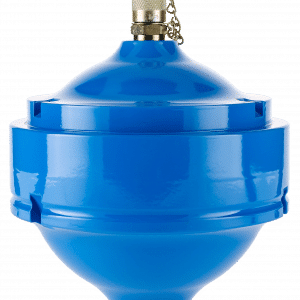
Piston accumulator (APL series)
Ideal for large volumes and slow cycles. Its mechanical robustness makes it the preferred choice for high-pressure systems and long-term energy storage. Advantages: high volumetric capacity, excellent pressure/volume ratio, ease of maintenance. APL series datasheet →
Spherical accumulator (AS series)
Compact and lightweight, it is perfectly suited to pressure shock dampening in confined spaces. Its low inertia delivers a very fast response time. Advantages: maximum compactness, instant response, ideal for pulsation dampening. AS series datasheet →
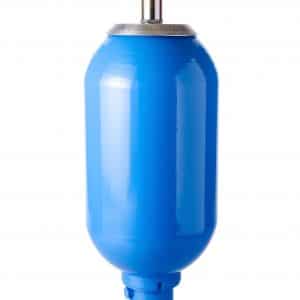
Bladder accumulator (ABVE series)
Optimal gas/oil sealing with flexible mounting orientations. Particularly effective for energy reserve applications and water hammer absorption. Advantages: reliable sealing, installation versatility, long service life. ABVE series datasheet →
OUR HYDROPNEUMATIC ACCUMULATOR RANGE
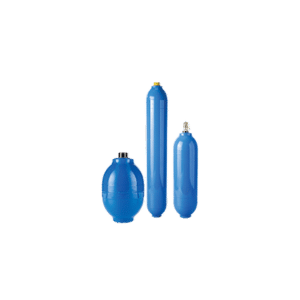
Hydro Leduc designs and manufactures three types of hydropneumatic accumulators, each suited to specific operating conditions and application requirements.
Piston accumulators — APL series
Best suited to large volumes and slow-cycle applications. High mechanical robustness for intensive use. APL series datasheet →
Spherical accumulators — AS series
Ultra-compact design for confined spaces. Fastest response time of the three families. AS series datasheet →
Bladder accumulators — ABVE series
Best gas/oil sealing performance. Flexible mounting in any orientation. ABVE series datasheet →
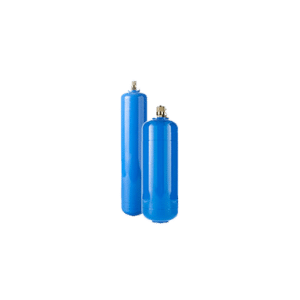
Welded cylindrical accumulators — ACS(L) series
For specific requirements in pressure resistance and compact form factor. ACS(L) series datasheet →
INDUSTRIAL USE CASES
Emergency energy reserve
Hydraulic presses, safety valve closures, industrial braking systems — the accumulator ensures continuity of movement during a pump failure, for as long as it takes the installation to reach a safe state.
Pressure shock dampening (water hammer)
The sudden stop of a fluid flow generates destructive pressure waves. Installed close to the source of disturbance, the accumulator absorbs these transients and protects the entire circuit. Critical in long-distance piping systems and handling equipment.
Volume and internal leakage compensation
In position-holding cylinders, micro-leaks at seals cause slow pressure drift. The accumulator compensates for these losses without calling on the main pump, reducing energy consumption and overall system wear.
Peak flow assistance
When an application momentarily requires a flow rate the pump alone cannot supply (fast valve opening, press cycle), the accumulator discharges to cover the peak — allowing a smaller pump to be used and saving energy during stand-by phases.
Aerospace and defence applications
A long-standing supplier to the aerospace and defence industries, Hydro Leduc designs accumulators for flight control servoactuators, landing gear systems and on-board equipment — meeting strict requirements for reliability, light weight and resistance to harsh environments (vibration, extreme temperatures).
FAQ — HYDROPNEUMATIC ACCUMULATORS
What is the difference between a piston, spherical and bladder accumulator?
All three are based on the same gas/oil separation principle, but differ in their separating element. The APL (piston) is suited to large volumes and slow cycles. The AS (spherical) is the most compact and reactive, ideal for rapid dampening. The ABVE (bladder) offers the best gas/oil sealing and adapts to many mounting orientations.
What gas is used in a hydropneumatic accumulator?
Nitrogen (N₂) only. The use of compressed air is strictly prohibited: the oxygen it contains can cause an explosion when in contact with hydraulic oils under high pressure.
How is the pre-charge pressure calculated?
Pre-charge pressure P0 is generally set at 0.6 to 0.9 times the minimum working pressure (Pmin). This ratio ensures the accumulator can fully discharge before circuit pressure reaches its lower threshold. Sizing also accounts for operating temperatures and the thermal regime (isothermal or adiabatic).
Are Hydro Leduc accumulators compliant with PED regulations?
Yes. All our accumulators comply with Directive 2014/68/EU and applicable ministerial orders. They are delivered with full regulatory documentation. We can also advise on periodic requalification requirements.
Can I order a custom accumulator?
Yes. Our engineering team designs accumulators with non-standard volumes, extreme pressures, special materials for aggressive fluids, or custom dimensions for constrained spaces. Contact our technical team for a personalised quote.
How should a hydropneumatic accumulator be maintained?
Maintenance includes regular pre-charge pressure checks (circuit depressurised), visual inspection for leaks, and inspection of the separating element. Periodic requalification is mandatory under PED regulations and must be carried out by qualified technicians.